
There is a specific kind of magic that happens when you step off the beaten path in Morocco. While most travelers flock to the vibrant red walls of Marrakech, those who journey just 50 kilometers south find themselves at the foot of the High Atlas Mountains in a town steeped in history: Amizmiz. It is here, tucked away in the Quartier Amadil, that I discovered a place that feels like a living bridge between the past and the present—the magnificent Riad Ouanaime.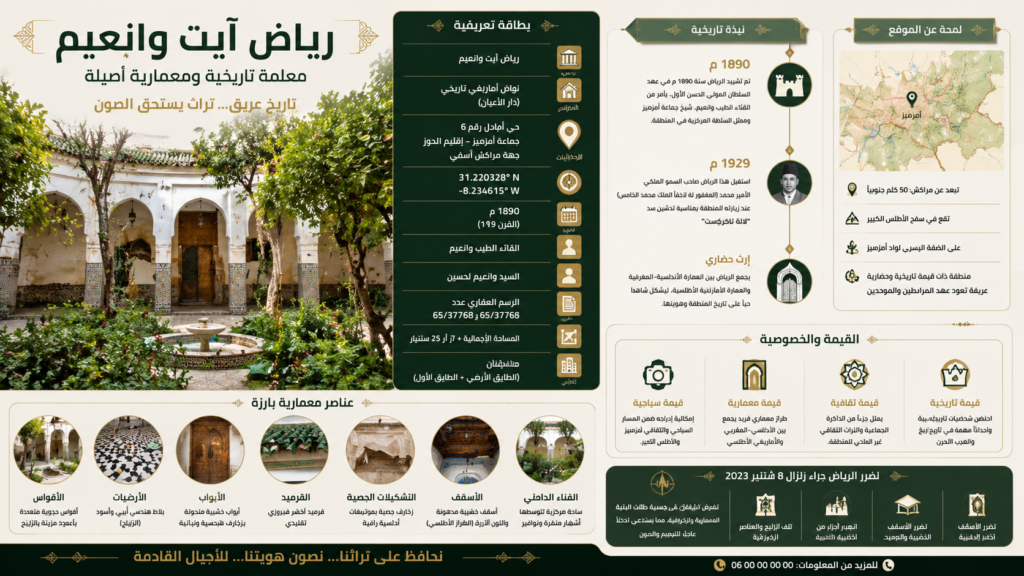
The Deep Roots of Amizmiz
To understand the soul of Riad Ouanaime, you first have to understand Amizmiz. Located on the left bank of the Oued Amizmiz, this town has roots reaching back to the Almoravid and Almohad dynasties. By the time the Alaouite dynasty rose to power, Amizmiz had become a vital political and commercial hub.
Walking through the streets today, you can still feel that ancient energy. The town serves as a guardian of the High Atlas, and its architecture reflects a blend of rugged mountain strength and refined city artistry.
The History and Builder of Riad Ouanaime
This riad isn’t just a building; it’s a monument to a specific era in Moroccan history. It was commissioned in 1890 during the reign of Sultan Moulay Hassan I. The visionary behind it was Caïd Tayeb Ouanaïme, the Sheikh of Amizmiz and a representative of the central authority in the region.
For the locals, the riad was more than a home—it was a seat of power. Its most famous historical moment occurred in 1929, when it hosted King Mohammed V (then the Crown Prince) during his visit to inaugurate the Lalla Takerkoust dam. Imagine the bustling activity within these walls as the Caïd met with French authorities and Moroccan royalty, shaping the social and political life of the High Atlas.
A Masterpiece of Amazigh-Andalusian Architecture
What makes Riad Ouanaime so visually arresting is its “Hispano-Mauresque” soul wrapped in an “Atlas Amazigh” cloak. It follows the traditional Moroccan floor plan centered around intériorité—a focus on the private, inner world.
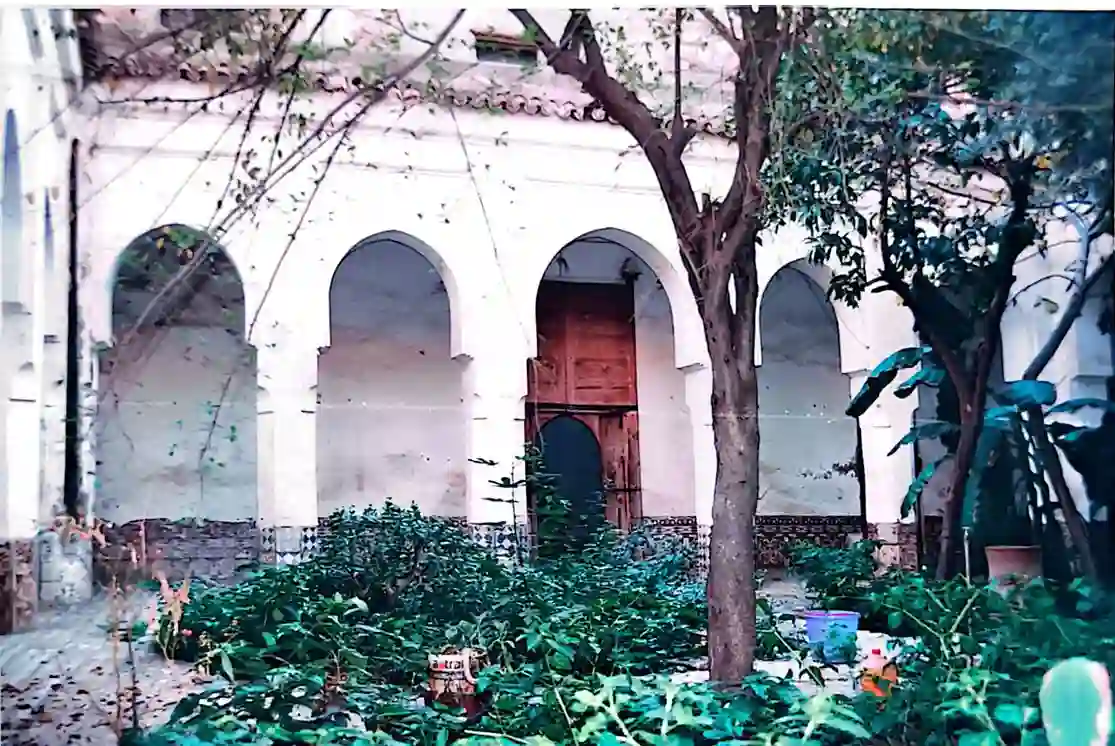
As you enter, you are greeted by a central patio (courtyard) open to the sky, surrounded by stunning horseshoe-shaped arches. These galleries are supported by columns adorned with intricate zellij (traditional tilework).
The craftsmanship found here is a testament to 19th-century artistry:
- The Sols (Floors): Geometric black and white zellij tiling that creates a mesmerizing rhythm underfoot.
- The Portes (Doors): Massive wooden doors carved with delicate floral and geometric motifs.
- The Plafonds (Ceilings): Traditional wooden ceilings painted in a distinct “Atlas style” blue.
- The Tuiles (Roofing): Vibrant turquoise-green tiles that catch the mountain sun.
The complex is sprawling, covering over 2,154 square meters. It includes the main riad, an adjacent school, and two large annexes known as Dar Saghit and Roubia El Kbir. In the heart of it all, centenarian orange and lemon trees still stand, their scent mixing with the mountain air.
The Current State: A Call for Preservation
It is important to be honest about the challenges facing this historic site. Today, Riad Ouanaime is in a state of advanced degradation. Decades of neglect were compounded by the devastating Al Haouz earthquake in September 2023.
Currently, large sections of the first-floor walls have collapsed, and deep cracks run through the supporting masonry. The beautiful wooden ceilings are damaged, and wild vegetation has begun to reclaim the central courtyard.
Despite this, the riad remains a site of “exceptional patrimonial value”. There is a growing hope that urgent restoration will transform this space into a cultural and tourist hub that can once again breathe life into the local development of Amizmiz.
Practical Information for Your Visit
If you are planning to explore this side of the Atlas, here is what you need to know:
- Location: The riad is located in the Amadil neighborhood of Amizmiz, Province of Al Haouz.
- Getting There: Amizmiz is an easy 50 km drive south of Marrakech. You can reach it via grand taxi or a private rental car.
- Best Time to Visit: Spring (March to May) and Autumn (September to November) offer the most pleasant weather for exploring the foothills of the Atlas.
- Visitor Tip: Since the building is currently fragile following the earthquake, always respect local safety signs and consider hiring a local guide who can share more stories about the Ouanaïme family legacy.
Reflection: Why Heritage Matters
Standing in the courtyard of Riad Ouanaime, you realize that Morocco’s beauty isn’t just in its restored palaces, but in its endurance. This riad has seen sultans, kings, and the changing tides of history. It reminds us that our perspective is just a small chapter in a much longer story.
Have you ever visited a place that felt like it was whispering secrets from the past? I’d love to hear about your experiences exploring the hidden corners of Morocco! Drop a comment below and let’s keep the conversation going.