
Table of Contents
Each year following Eid al-Adha, communities across Morocco’s Amazigh heartland — most notably in the High Atlas region, including the town of Amizmiz in Al Haouz province — perform the ancient festival of Boujloud, known in Tamazight as Bilmawn. The practice involves participants donning fresh goat or sheep skins, wooden or leather masks, and bells, before parading theatrically through village streets. In recent years, this tradition has faced accusations of being a “satanic” or “demonic” ritual, a characterisation this study contends is factually unfounded. Through comparative anthropological analysis, this article demonstrates that Boujloud shares structural, symbolic, and functional characteristics with no fewer than seven traditions registered or documented by UNESCO, the Smithsonian Institution, and major European cultural bodies — spanning Sardinia, Slovenia, Croatia, Spain’s Basque Country, Austria, Romania, and Moldova. The study further contextualises Boujloud within pre-Islamic Amazigh agricultural cycle rituals and argues for its recognition as a form of intangible cultural heritage deserving systematic documentation and protection.
Historical and Cultural Origins of Boujloud
The days following Eid al-Adha in Morocco’s Amazigh communities witness one of the most theatrically arresting folk performances in North African cultural life. Young men — and occasionally women — envelop themselves in freshly prepared animal skins, typically goat (agus in Tamazight) or sheep, their faces hidden beneath carved wooden or leather masks. Accompanied by percussive music and communal singing, these performers traverse the public squares and narrow lanes of their villages in a tradition known variously as Boujloud (from the Moroccan Arabic bu jlud, “father of skins”) or Bilmawn in the Tamazight language of the Amazigh people.[1]
While the festival is now calendrically anchored to Eid al-Adha — a central Islamic observance — the scholarly consensus holds that its roots substantially predate the Islamisation of North Africa in the seventh century CE. Researchers and ethnographers who have studied Amazigh communities in the Souss valley, Anti-Atlas, and High Atlas mountains — including the Amizmiz area, situated roughly 55 kilometres south-west of Marrakech — trace Boujloud’s structural features to pre-Islamic agricultural calendar rituals associated with seasonal transitions, livestock fertility, and communal propitiation.[2] The festival’s absorption into the Islamic calendrical framework represents a common pattern in Maghrebi religious and cultural history: the accommodation of indigenous ritual cycles within new devotional structures, rather than their elimination.
The skin-preparation process itself attests to the tradition’s deep embeddedness in pastoral community life. Fresh hides must be treated with water and salt over a period of four to five days to remove the intense odour and preserve the fur — a process that requires preparation, communal coordination, and craft knowledge passed between generations.[2]
The Characters and Social Theatre of Bilmawn
What distinguishes Boujloud from a simple costume parade is its elaborately structured dramatic cast. The eponymous central figure — Boujloud himself — functions as the organisational leader and symbolic anchor of the procession: dressed in a complete goat skin with the animal’s head preserved as a mask, he wields an actual goat leg, using it to playfully (if somewhat forcefully) engage spectators along the route. His role combines those of trickster, guardian, and master of ceremonies — a configuration with close parallels in the ritual dramaturgy of many pre-modern European folk traditions.[2]
The supporting cast is no less significant. A sociology student who participated in the festival described to Bewildered in Morocco how the performance features characters representing multiple religious traditions: Muslim, Jewish, and Christian figures; itinerant merchants and herbalists; and cross-dressed “old lady” characters performed by male participants. This theatrical plurality is not incidental. As one performer articulated: “Back in the day, Jews and Muslims lived together side by side. Ancient civilisations, especially the Amazigh, interacted with these different cultures.”[2] Boujloud thus functions, in part, as a living archive of the High Atlas’s multi-religious past — a quality that renders it particularly valuable from a heritage studies perspective.
You can’t just view it from one perspective. You have to look at it from a political angle, an economic angle, a mythical one, a theatrical perspective, and even as a form of resistance.
The festival’s multi-dimensionality is explicitly articulated by its participants. One sociology student involved in the Amizmiz-area celebrations told researchers: “It’s no longer just a celebration in a small neighbourhood. It turned into something bigger… You have to look at it from a political angle, an economic angle, a mythical one, a theatrical perspective, and even as a form of resistance.”[2] This reflexive self-understanding — positioning Boujloud as simultaneously ritual, political commentary, and artistic performance — aligns with how scholars of carnival theory, from Mikhail Bakhtin to Peter Burke, have understood the social function of pre-modern folk festivities.
The Anthropology of Masquerade: Skin, Bell, and Procession
The central symbolic elements of Boujloud — animal skin, mask, bells, communal procession — are not arbitrary. Anthropological scholarship on ritual masquerade identifies these elements as constitutive of a nearly universal semiotic vocabulary in pre-modern pastoral and agricultural societies. The mask, cross-culturally, does not signify evil; rather, it creates a liminal threshold, a bounded space within which the ordinary social order is temporarily suspended and symbolic forces — fertility, renewal, communal solidarity, the expulsion of misfortune — are ritually invoked and enacted.
The animal skin carries related symbolic weight. In pastoral societies, the bodies of domesticated animals represented fundamental economic and existential resources. Wearing their skins was not a gesture of identification with darkness, but rather an assertion of the deep entanglement between human community and animal world — what anthropologists of religion term “sympathetic” or “totemic” logic. The bells, meanwhile, serve a function explicitly documented across multiple traditions: their noise was believed to drive away malevolent spirits and harmful forces, and to call forth the energies of spring and fertility.[4][5]
The mask does not signify evil. It creates a liminal threshold within which symbolic forces — fertility, renewal, communal solidarity, the expulsion of misfortune — are ritually invoked. This function is documented across dozens of traditions on four continents.
Crucially, these interpretations are not projections of Western ethnographic theory onto Moroccan material. They are confirmed by the participants themselves, and by the structural parallels — discussed in the following section — observable in traditions that UNESCO and major cultural institutions have independently documented and, in several cases, formally inscribed on the Intangible Cultural Heritage register.
Global Parallels: A Comparative Survey of Analogous Traditions
The most persuasive rebuttal to the characterisation of Boujloud as a uniquely aberrant or suspect practice is straightforwardly empirical: documented traditions employing the same constellation of elements — animal skins, grotesque masks, large bells, collective processions, and symbolic associations with fertility and seasonal transition — exist across Europe and have been subject to serious institutional recognition.
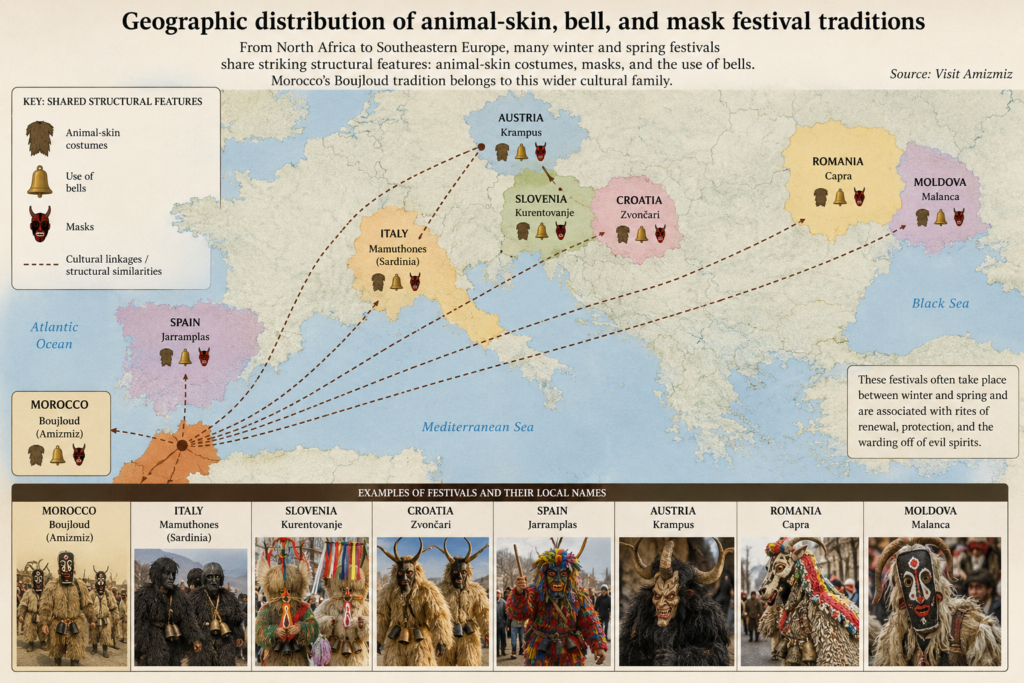
Fig. 1. Geographic distribution of animal-skin, bell, and mask festival traditions. Morocco (Boujloud) shares structural features with traditions across Italy, Slovenia, Croatia, Spain, Austria, Romania, and Moldova. Source: Visit Amizmiz.
| Tradition | Country / Region | Core Elements | Symbolic Function | Status / Source |
|---|---|---|---|---|
| Boujloud / Bilmawn | Morocco — High Atlas, Souss, Amizmiz | Goat/sheep skins, masks, goat-leg prop, theatrical cast | Seasonal transition; community memory; social satire | Morocco World News[1] |
| Mamuthones | Italy — Sardinia (Mamoiada) | Black sheepskin, heavy black masks, large cowbell belts worn on back (“sa carriga”) | Ancient pastoral rite; communal procession led by su guidadore | mamuthones.it[3] |
| Kurenti | Slovenia — Ptuj region | Dense fur costume, grotesque masks, large bells; door-to-door rounds | Drive away evil spirits; invite fertility and good fortune | UNESCO ICHich.unesco.org[4] |
| Zvončari | Croatia — Kastav area | Sheepskin capes, large bells at waist, evergreen-adorned hats; village marches | Expel winter; summon spring; led by guide with evergreen tree | UNESCO ICHich.unesco.org[5] |
| Joaldunak | Spain — Basque Country | Up to sixty participants with large clanging bells strapped to backs; inter-village procession lasting hours | One of Europe’s oldest documented bell-procession traditions | Smithsonianfestival.si.edu[6] |
| Krampus / Perchten | Austria, Bavaria, Switzerland | Dense fur, terrifying carved masks, bells; December parades | Represent forces of nature and winter; accompany St. Nicholas; misrepresented as “demonic” outside their cultural context | salzburg.info[7] |
| Capra / Ursul | Romania, Moldova | Full animal-skin costumes; theatrical “Bear dance” and “Goat dance” performances | Seasonal renewal; expulsion of evil; performed during winter solstice / New Year period | romania-insider.com[8] |
The structural homology across these traditions is striking. Each involves (1) the wearing of animal skins or dense fur; (2) masks — often designed to be frightening — which conceal ordinary identity and create a liminal performer; (3) large bells whose noise is understood to have apotropaic (evil-averting) or invitatory (spring-welcoming) power; (4) collective procession through community space; and (5) an underlying symbolic logic of seasonal transition, fertility, and the boundary between harmful forces and communal wellbeing. None of these — including the frightening masks — are understood by their communities or by ethnographers as expressions of diabolism or Satanism.
Two of the seven comparative cases — Slovenia’s Kurenti and Croatia’s Zvončari — are formally inscribed on UNESCO’s Representative List of the Intangible Cultural Heritage of Humanity.[4][5] A third, the Joaldunak of the Spanish Basque Country, has been featured and documented by the Smithsonian Folklife Festival as an exemplary case of living folk tradition.[6] The Krampus / Perchten tradition of the Austrian Alps is actively promoted by Salzburg’s tourism authorities as a cultural asset of regional identity.[7]
The Problem of Misrepresentation: Between Legitimate Critique and Cultural Demonisation
The recurrent characterisation of Boujloud as a “satanic” ritual in Moroccan social media and popular discourse reflects a broader pattern of what anthropologists term “iconoclastic” misreading: the application of framework categories derived from one cultural or theological tradition to the material forms of another, with no sustained engagement with the tradition’s own internal logic or comparative context.
This is not to suggest that Boujloud celebrations are immune from legitimate critique. Anthropologists and festival participants alike have noted that some performances involve behaviours that cause physical discomfort or that exceed the bounds of respectful communal interaction. Questions of gender dynamics, boundary-maintenance, and the commercialisation of folk performance are all legitimate subjects for internal community deliberation and scholarly attention.
However, there is a categorical distinction between (a) empirically grounded critique of specific practices within a tradition, and (b) the wholesale characterisation of that tradition as diabolical or antithetical to religious life. The former is a contribution to cultural self-determination; the latter is a form of heritage destruction. As Morocco World News noted in its 2024 analysis of the festival, the controversies surrounding Boujloud are inseparable from broader tensions over Amazigh cultural identity in a society where the dominant Islamic public sphere has historically struggled to accommodate pre-Islamic cultural forms.[1]
There is a categorical distinction between empirically grounded critique of specific practices within a tradition, and the wholesale characterisation of that tradition as diabolical. The former is a contribution to cultural self-determination; the latter is a form of heritage destruction.
Instructive in this regard is the case of the Krampus tradition in Austria and Bavaria. For decades, Krampus — a figure whose masked, fur-covered, bell-wearing appearance is structurally near-identical to Boujloud — faced precisely the same charges of diabolism from conservative religious quarters in Central Europe. Those objections have been progressively marginalised as the tradition has been reframed through the lens of cultural heritage and regional identity, and is now celebrated as a tourist and cultural asset by the city of Salzburg.[7] The lesson is instructive: what one generation condemns as demonic, another recognises as heritage.
Towards Documentation, Protection, and Recognition
Boujloud and Bilmawn constitute a significant and living element of Morocco’s Amazigh intangible cultural heritage — one that is particularly vital in communities like Amizmiz, where the High Atlas geography has historically sheltered Tamazight linguistic and cultural practices from the homogenising pressures experienced in urban Morocco. The festival functions simultaneously as a theatrical archive of pre-Islamic agricultural cosmology, a performance of multi-religious communal memory, a space for social satire and political commentary, and a marker of Amazigh cultural continuity across generations.
The comparative evidence surveyed in this article makes the anthropological case unambiguously: Boujloud belongs to a well-documented, globally distributed family of pre-modern pastoral masquerade traditions whose structural vocabulary — skin, mask, bell, procession — expresses a universal human logic of seasonal transition and communal renewal. To characterise it as a uniquely suspect or diabolical practice is to demonstrate unfamiliarity with the comparative record, not familiarity with theological truth.
What is required is not a defence of every specific practice associated with Boujloud celebrations, but a commitment to the principle that the tradition merits the same institutional seriousness accorded to the Kurenti of Slovenia, the Zvončari of Croatia, and the Joaldunak of the Basque Country. Morocco has the institutional framework — through the Ministry of Culture, Ircam, and the growing infrastructure of Amazigh cultural advocacy — to pursue formal documentation and potential nomination of Boujloud to UNESCO’s Intangible Cultural Heritage lists. Amizmiz, as one of the tradition’s most authentic living sites, would be a natural focal point for such an initiative.
- Faouzi, A. (2024). Boujloud: Where Sheepskins and Spirits Intertwine. Morocco World News.
moroccoworldnews.com/2024/06/18355/boujloud-where-sheepskins-and-spirits-intertwine/ - Said. (2025). Boujloud Festival: Morocco’s Fascinating Goat-Skin Celebration. Bewildered in Morocco.
bewilderedinmorocco.com/boujloud-festival-morocco-amazigh-tradition/ - Associazione Mamuthones. (n.d.). The Ritual. Mamuthones Official Website.
mamuthones.it/en/the-ritual/ - UNESCO. (2017). Door-to-door rounds of Kurenti. UNESCO Intangible Cultural Heritage Representative List. RL-01278.
ich.unesco.org/en/RL/door-to-door-rounds-of-kurenti-01278 - UNESCO. (2009). Annual carnival bell ringers’ pageant from the Kastav area. UNESCO Intangible Cultural Heritage Representative List. RL-00243.
ich.unesco.org/en/RL/annual-carnival-bell-ringers-pageant-from-the-kastav-area-00243 - Smithsonian Folklife Festival. (2016). The Joaldunak from Head to Toe. Smithsonian Institution.
festival.si.edu/blog/2016/the-joaldunak-from-head-to-toe - Salzburg Tourism. (n.d.). Krampus and Perchten. Salzburg.info — Official Tourism Portal.
salzburg.info/en/salzburg/advent/krampus-percht - Romania Insider. (2021). Winter holidays and Christmas traditions in Romania: the Bear dance, the Masked carolers and the Goat. Romania Insider.
romania-insider.com/winter-holidays-and-christmas-traditions-in-romania…